I do not like them here nor there, I do not like them anywhere.
Working in the area of sustainable diets has always made me feel a little bit like Sam I Am from Dr. Seuss’ classic green eggs and ham: there’s just something about meat reduction that rubs a portion of people up the wrong way.
That’s fine and their prerogative, but boy do some people take anyone else reducing meat personally.
Now I’m not wearing rose-tinted spectacles here, meat reduction has barriers. I love tofu as much as the next person (likely considerably more), but it took some experimenting to get there, and try as I might have never gotten to that same point with tempeh. I eat beans all the time, but for me they are not a main event (and putting them in a jar of stock and charging £5 for them doesn’t change that).
For me, meat alternatives are what I get most excited about (sue me). I know they have limits, but I feel about meat alternatives how Marge feels about potatoes.
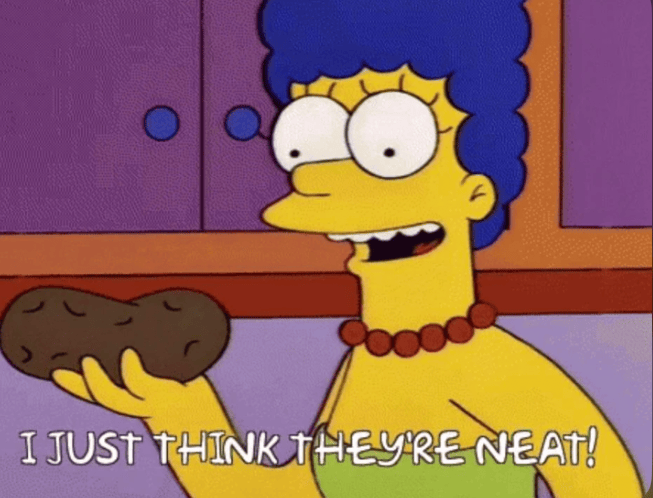
I like how they taste, I find them fun to cook with, I like finding new ones and playing around with them, I think it’s cool how you can make beans into meat with a strangely shaped pressure cooker.
But I get it that not everyone is bought in.
They are getting better and better but they vary a lot in quality, and they are often expensive. I also get that the idea of these foods sometimes occupy a bit of an unappetising uncanny valley. I can vividly remember sitting before a large grey plate of plant-based tripe – a food I’ve never even had the animal version of – with excitement at the novelty fast being replaced with a questioning of my choices.
If you could not, would not, that’s your decision, but in recent years the argumentation has shifted. A little less “I do not like green eggs and ham” and a little more Gaslight. Especially when it comes to meat alternatives.
All of a sudden, it’s not that they are a bit expensive, a bit shit and/or a bit weird, they are actually, fundamentally, everything wrong with our current food system, and anyone who disagrees is probably an industry hack.
They say you don’t want to know how the sausage gets made – but wait till you see what nefarious shenanigans go into plant-based ones.
Did you know they are engineered by big evil corporations? They are so processed that their environmental footprint is catastrophic? They are made of soy that’s monocultured in the Amazon? They are full of so many additives, high in salt, fat AND sugar (🤔) devoid of fibre, protein and indeed anything remotely nutritive that they constitute a full on health hazard?
It’s ironic really because I could have sworn that several of those were the problems that they were trying to solve in the first place.
In the possibly apocryphal words of Ronald Reagan, if you’re explaining you’re losing, so we won’t debunk all of this here, but suffice it to say if you have even the slightest genuine curiosity as to whether these are fair and proportional claims to make, you will quickly find they usually aren’t.
So where, dear reader, did they come from?
Around 2019, the dry but well-meaning veggie sausage got a makeover. This new generation wasn’t ‘vegetarian’, it was ‘plant-based’. It wasn’t packaged in green and brown hippie colours with an old-school font, tucked in the fridge at the health-food shop. It had normal looking branding and was in Greggs like normal food is.
Worst of all, these sausages had the temerity to suggest that people might want to eat them even if they weren’t vegetarian.
This new generation really captured a moment. Overconfident quotes from bullish US startups dominated the headlines, and food outlets rushed to make vegan versions of their most popular offerings. A high-profile IPO promised investors the returns of a tech company by selling – get this – vegan burgers. And remarkably everyone lapped it right up.
Hindsight is 2020 but everyone really did get a bit over their skis on the whole thing.
Emboldened, this handful of idealistic, pre-profitable startups armed with some extruders and dubiously optimistic promises went all guns blazing at a trillion dollar industry renowned for its lobbying power.
If you come at the king, you better not miss.
And boy did they miss.
How do you spell methylcellulose?
Most people don’t eat plant-based meat, or have regular contact with it. This means it is particularly vulnerable to stereotypes, and since 2018 these have been on a bit of a journey.
The baseline was the well meaning but fundamentally unthreatening protein cardboard you ate when you went to your vegetarian friend’s house. Then, for a brief few years they were the edgy and at times even cool food of the future. And then, alas, came the era of the nutritionally stunted food-like substance.
In 2020, the Center for Consumer Freedom (now known by the less conspicuous Center for Organizational Research and Education), a large US corporate lobby group that represents the alcohol, meat and tobacco industries, ran an advert in one of the most expensive and watched slots on the planet: US Super Bowl halftime. The ad featured a spelling bee where cute kids try and fail to spell methylcellulose and propylene glycol, before the day is won by a final kid who is asked to spell bacon. It was a simple message for the millions of viewers across the US: plant-based meat is full of ingredients that are long and complicated, and you shouldn’t trust it.
This was among the first public campaigns linking meat alternatives to the subject of processing.
From a pure narrative building point of view, the positioning of UPF as a counter to plant-based meat is artful. It’s a case study in marshalling public opinion that Freud’s chaotic neutral nephew and inventor of PR Edward Bernays himself would have been proud of.
“Propaganda is of no use to the politician unless he has something to say which the public, consciously or unconsciously, wants to hear.”
Edward Bernays, Propaganda, 1928
Because while a lot of people understood the arguments around plant-based meat and there was growing curiosity about it, these were still early days and even the good ones were expensive.
But unlike tofu, whose general reputation in western countries as disgusting gave everyone the social licence to ignore it, despite their shortcomings meat alternatives left less room for excuses.
People knew they could and maybe even should eat less meat, but didn’t especially want to.
And so they were fairly open to the idea when someone somewhere told them that food being ‘fake’ was the new proxy for its health, environmental and societal impacts, rather than actual measurements of these things.
And surprisingly, the direct-to-YouTube response to the ad from one of the plant-based startups, with its mature and disciplined message that meat had shit on it or something, did little to take the edge off.
It wasn’t just meat alternatives taking a hit, this new narrative also glazed animal products like nothing in a while had. Meat had spent years in the wilderness, struggling to find a modern identity amid growing awareness of its harms, and distrust of its increasingly conglomerated and dystopian tendencies. But now it seemed to be getting its mojo back.
The Center for Consumer Freedom ad and site are on the nose, but the discourse it drew from was organic and much more sophisticated. It was actually a discourse whose most recent manifestation had been re-ignited by one of big meat’s vocal critics.
Eat real food, mostly plants, not too much
The Omnivore’s Dilemma (2006) by Michael Pollan was a deeply influential book. The first ever paper on UPF by Carlos Monteiro – the term’s inventor – ends with this. ‘[I] acknowledge and recommend the work of Michael Pollan.’ This is unusual for a scientific paper, which is why I read the book and is what started me down this rabbit hole in the first place. It would turn out the germinal seed for the Nova system is stated more explicitly in this book than I expected.
The Nova system defining UPF builds on a longer history of discourse on ‘nutritionism’ and the ‘chemicalisation’ of food. This is a topic which Monteiro and his frequent collaborator Geoffery Cannon by the early 2000s were veterans of. However, they had struggled to convince the academic establishment, and it had been a long time since any attempt to generate mainstream public interest had made meaningful inroads.
Now Cannon is a really interesting figure with a remarkably eclectic career.* He is also a huge fan of Michael Pollan. It was he who first invited Monteiro’s initial paper on Nova when he was a columnist at the journal Public Health Nutrition, and he is listed as final author on it. He worked directly with Monteiro’s team at the University of São Paolo devising the system, a team who he described as “devoted to Michael’s work”.
Cannon characterises Pollan’s role as the communicator who brought their arguments to public salience and helped popularise the concept of UPF. In a 2013 article he recalled how Pollan “has advertised the ‘ultra-processing’ commentaries that Carlos Monteiro, I and colleagues have published…, and each time our page traffic has spiked.”
The Omnivore’s Dilemma is one of those books where a little lightbulb keeps going off in your head ‘ooooh is this where that comes from’. From a proposed food categorisation model using four levels of processing, to the call to eat ‘real’ food and warnings against food that isn’t food, to the chemicals turning the frogs gay that so alarmed puce conspiracy theorist Alex Jones. It covers a lot of diverse memetic ground.
In broad brushstrokes, the book’s thesis argues that the structures and mores that have shaped how we eat for millennia are being dismantled by our ever expanding quest for efficiency and optimisation, and in doing so we are breaking something we don’t know how to fix. As a result, fads and paranoia have sprung forth promising pathways through the maze created by bottomless knowledge and endless choice. It’s Weber’s Entzauberung applied to our modern food system. The vehicle by which this happens, the book contends, is ’processing’, though to modern understandings of that word it’s perhaps best characterised as ‘valorising’.
Just as Keats lamented two hundred years ago how Isaac Newton had ruined the magic of rainbows by explaining them, Pollan turns this time-honoured perspective to food.
Now I think elements of this thesis have a decent amount of explanatory power. But the arguments laid out in the introduction aren’t exactly what the book goes on to argue. In particular, as the book progresses there is an increasing obsession with what nature intended, and a persistent characterisation of reductionist ‘science’ at the root of the problem.
*As an aside, Cannon’s late wife Caroline Walker is a fascinating individual for anyone interested in the history and discourse pre-dating Nova around public health and nutrition, as is the post-war history of this discourse more broadly.
A koala bear’s take on the naturalistic fallacy
But while society’s tendency towards excess and hubris is fairly self-evident, the conclusion that this is science’s doing, and that nature knows what’s best for us, needs more substantiation. The recurrent motif of koala bears within the book are emblematic of this.
Koalas, the book asserts, do not face the same burdens we do. The little marsupials are lucky. They must eat eucalyptus and don’t have to think twice.
But acting as though koalas are in any way enviable is a particularly striking example of the naturalistic fallacy at play.
A koala’s main food is eucalyptus, which is poisonous. This means they don’t face much competition for it, but this comes at a price. Their little brains are smooth because their food can’t provide the energy to make a normal mammal brain, and they are consequently always tired and pretty stupid.
During weaning, they must eat their mother’s excrement to build up gut bacteria that can break down the toxic compounds. They also as a species have a nasty chlamydia problem.
Now I’m not just using this to pick holes in what was clearly intended as a simple analogy, but it’s a fairly good example of how assuming nature = good is reductive. The engine of natural selection does not select what is necessarily ‘best’ for everyone involved, it selects for whatever will best replicate in its given condition, that could be chlamydia-ridden tree bears, it could be worms that reproduce by making children go blind, it could be the great barrier reef.
In short, it doesn’t really feel like it’s a betrayal of nature and our biology as omnivores that explains what is going wrong.
We’re all omnivores, you’re a meat eater
When I was a kid we didn’t hide behind overly generalised appropriations from biology, we happily self described as meat eaters (OK boomer). Nowadays it seems we use the more euphemistic ‘omnivore’ to discern people who eat meat from pescatarians, vegetarians and even flexitarians, even though every one of those diets are definitionally omnivorous.
Judging by the strange descriptions of eating salad making him feel like a ‘herbivore’ and his constant badgering of the various farmers he meets on his journey for free steak and chicken, meat eating seems to be the defining feature of what Pollan understands by the term omnivore (and by extension his biological inheritance) too.
Throughout his adventures the sins of other foods are emphasised while the very same are glossed over in meat. He only considers the climate footprint of agriculture in terms of fossil fuel usage and transport, ignoring the far larger impact of primary production (though maybe in 2006 this was a bit more forgivable).
He describes the very real problem that the primary producers of food only earn a very small proportion of the amount it is ultimately sold for. He points to eggs as an exception because the chicken farmer gets a larger cut (forgetting the last two chapters we spent with the people who grow the corn that feeds those chickens).
He is very impressed by his visit to a pasture-fed beef farm, owned by regenerative farming advocate Joel Salatin. He repeats at face value several claims about scalability and sustainability, while comparable claims made by other food system actors in the book are presented with a more healthy dose of skepticism.
However, he doesn’t flinch at the problem of industrial meat, and some of the most memorable parts of the book are the trip to the feedlot and the wretched existence of the little calf he bought to follow through the system.
Eating meat is of course something humans have always done, so it feels natural in a way eating Pringles doesn’t. However, as the Omnivore’s Dilemma highlights, the way most meat is produced today, and the amount of it we currently eat, is anything but.
As such, modern meat sits at the crossroads of natural and unnatural, with the animals themselves acting as useful vehicles to launder the human interventions in production. And without vigilance to keep production centred, it’s tempting to look away.
This problem has become apparent in the modern processing discourse – which does not give the same attention to industrial meat production as Pollan does. They gesture at problems caused by processed meat like chicken nuggets and teddy bear ham, but a chicken breast from an industrial farm (the overwhelming majority of chicken breasts) is Nova 1 just like a carrot you just pulled out of your garden.
This blind spot seems especially relevant when industrial meat typifies almost every structural problem Nova seeks to challenge.
Is it the chemicals or is it the corn?
The loss of industrial meat in the transfer from the Omnivore’s Dilemma (which primarily focuses on structural drivers), to Nova (which defines foods largely in terms of end-product characteristics) also seems to remove a significant proportion of the latter hypothesis’ explanatory power.
The first section of Pollan’s book presents the following hypothesis:
- Structural incentives and scientific advances in the early 20th century inadvertently incentivised massive over-production of corn in the US food system.
- Faced with far more cheap corn than there was any reasonable demand for, ways of valorising it became expressly valuable.
- The most effective ways of turning this surfeit of corn into something people would pay for and eat lots of have become the primary drivers of the chronic disease and inequality endemic in our food system.
When looking at where the corn went, Pollan runs out of road pretty quickly because most of it (three fifths) goes to making meat, and most of the remaining two fifths goes to making sugar (namely high fructose corn syrup).
I found the simplicity of this – and just how accurately this observation from 20 years ago predicted the outcomes we see in UPF research today – a little bit jaw dropping.
Because time and time again, when UPF studies don’t mash everything together and instead look at individual food groups, they find something remarkably consistent: basically all of the increased risk is explained not by ‘ingredients your grandmother wouldn’t recognise’ but by a surfeit of processed meat and sugary drinks.
It’s always been quite interesting to me that in UPF studies, even things we know are bad for you in excess aren’t always associated with strong health differences. This is a quirk of how the studies work – most likely because some unhealthy foods aren’t particularly over-represented in the diets of people who eat lots of junk food generally.
So if my hypothesis was, ‘people who struggle to eat a healthy diet get primarily derailed by cake in the office they feel awkward saying no to’, we might expect to see cake particularly strongly linked to poor health outcomes in UPF studies. But that’s not what we see.
If my hypothesis was ‘the things that were most successful at making money out of dirt-cheap corn are disproportionately eaten in unhealthy diets’, we’d see industrial meat and high fructose corn syrup driving those risks.
Which we do.
Now obviously this kind of research is hugely messy and there could be all sorts of explanations behind what we see, but it’s in the least quite a striking coincidence.
After his trip to a beef feedlot, followed by the discussion of sugar and high fructose corn syrup in US diets, Pollan alights on the subject of additives. He quite clearly enjoys this part of his story in a way he really didn’t seem to enjoy the beef feedlot (not that I can say I blame him).
It’s here that the Nova we know and love starts to shine through. The endless paragraphs listing random chemical-sounding additives and childish sneers that the same things are sometimes used in shampoo.
What’s mycoprotein got to do with it?
But among these nefarious ingredients, was one that made me pause.
Because it was mycoprotein.
Like…. seriously?
If you don’t know what mycoprotein is it’s essentially a food made by growing filamentous fungi – think the white stuff in tempeh. It’s not especially processed by any reasonable definition. It’s been available in the UK since the 1980s but elsewhere even today it’s pretty niche.
When the book was writen, mycoprotein had been on sale in the US for only 4 years, and had to be specially imported from the UK.
Therefore to find it mentioned, of all places, in a book from 2006 about the evils of the US food system, seemed odd.
We see this too in the broader way in which the Nova discourse has stuck so fast to meat and dairy alternatives. Soy milk is for some reason UPF even though it’s centuries old, while intensively farmed cow milk is Nova 1.
Because no matter what methods are used to make modern meat and dairy, replacing it with something else is what feels unnatural.
Ok, but what does this have to do with Nova?
After leaving the feeding lot, the ‘processing plants’ section alights on four ‘ages of processing’:
“So we learned to salt and dry and cure and pickle in the first age of food processing, and to can, freeze, and vacuum-pack in the second.”
This maps pretty directly onto Nova 1, 2, and 3 as well as chronologically with the common shorthand ‘ingredients your grandma would recognise’.
“In the third age of food processing, which begins with the end of World War II, merely preserving the fruits of nature was deemed too modest: The goal now was to improve on nature. The twentieth-century prestige of technology and convenience combined with advances in marketing to push aside butter to make shelf space for margarine, replace fruit juice with juice drinks and then entirely juice-free drinks like Tang, cheese with Cheez Whiz, and whipped cream with Cool Whip…The longer the ingredient label on a food, the more fractions of corn and soybeans you will find in it.”
“Evidently we’re moving into the fourth age of food processing, in which the processed food will be infinitely better (i.e., contain more of whatever science has determined to be the good stuff) than the whole foods on which they’re based. The food industry has gazed upon nature and found it wanting – and has gotten to work improving it.”
This final age aligns very closely with Nova 4, both in character and ‘purpose’ which is an important part of Nova.
The problem here is that Pollan’s fundamental thesis argues the reason we are in this mess centres on a societal problem that is broadly science and economics getting too involved in food (which while imperfect has some validity). Nova however tries to describe this complex structural problem ‘scientifically’.
And that’s not really something that is possible to do.
Urgh… Science
Even my millennial heart, trapped eternally in the ‘I fucking love science’ era, will tell you that you can’t ‘do science’ on everything.
Some questions just don’t have a falsifyable answer: Should you press the red button or the blue button?
Sometimes, we need stories to make sense of things – because there are too many moving parts and complexities for any one explanation or framework to capture. Nova is far more a story than it is a science, and it has clearly found profound resonance. It gives voice to feelings of distrust and loss of agency in navigating what to eat, a yearning to go back to a simpler time when we weren’t bombarded constantly with conflicting information. But as any koala will tell you, reductiveness isn’t only a flaw of scientists. It also has a nasty habit of shaping narratives.
The scientific method is a framework for testing whether what we think is true holds up. When applied correctly it is dispassionate, objective, and neutral (things we as humans are not naturally inclined to be). But the stories we tell ourselves shape the questions we ask, and the datasets we have can’t always tell us what we need to know. When we think we’re doing science but haven’t posed the question correctly, it’s easy to get unstuck.
If we aren’t careful, this can strengthen our convictions more than is warranted, make us view our beliefs as objective, and distort how we see the world. It can highlight the things we like, and obscure the things we’d rather ignore.
This is a field trying to counter the intrusion of facts into the realm of culture. It is therefore not surprising that one of our favourite foods with a lot of inconvenient truths comes quickly and unconsciously to the fore.
The Omnivore’s Dilemma part 2: electric boogaloo (AKA Ultra-Processed People)
This first iteration of the Nova discourse, popularised by influential figures like Pollan and Marion Nestle, was often broader and more structural in its critique. It also often focused quite squarely on industrial animal farming alongside the chemicals.
And yet, it was nevertheless this narrative that the Centre for Consumer Freedom and whoever created their ads decided to hitch their wagon to in their 2020 Super Bowl ad, and as luck would have it for them, the second wave that was about to break would pay considerably less attention to industrial meat.
Chris van Tulleken, the author of ‘Ultra-Processed people’ is actually quite open about the fact that writing the book in the first place wasn’t his idea. He describes it being suggested to him by his TV producer, who gave him a print out of Kevin Hall’s 2019 paper and one of the early papers from Carlos Monteiro and his team.
Having identified these papers as a good hook, Dr Chris and his producer embark on a TV documentary revolving around an N=1 ‘study’ for the BBC, which was essentially a UPF reboot of Super Size Me. This docu-’study’ was also the narrative throughline of the book.
In writing the book and introducing him to this topic however, van Tulleken had help from a familiar face. He acknowledges particularly “Geoffrey Cannon (who spoke for hours and sent me a huge quantity of valuable research)”.
In the same 2013 article where Cannon spoke of the importance of Pollan in popularising his concerns around nutritionism, he argues for more localised versions of the Omnivore’s Dilemma for different countries “Michael needs filtration and translation. For people from Australia or England say, or from Western Europe, this is perhaps not much more than a matter of accent.”
As such, I am not a betting person but I’d wager the Omnivore’s Dilemma (as well as ‘In Defence of Food’ which followed it) was in Chris van Tulleken’s reading list from Cannon, and (though this is entirely supposition) that Cannon at least to some extent hoped van Tulleken’s track record as a TV doctor and communicator would enable him to affect the UK similarly to how Pollan had the US.
If I’m right, I’d say that Cannon was fairly bang on the money.
The naturalistic fallacy in a lab coat
Reading ultra processed people creates a strange sense of whiplash as we flip from inferences from studies in the 1930s where they stitched two rats together, followed by nods to the importance of methodological rigor and concessions that the experiment we just looked at was entirely lacking in any.
I don’t want to labour the point, but the book pays a lot of lip service to science while also implying some very unscientific things. Some of these are fairly inane, like this chemical has been used and studied for years and there’s no evidence it’s harmful, but you never know (and it’s in condoms lol), to things that are well on their way to dangerous misinformation like “a poor diet may have worse effects for many people than even very heavy smoking.”
And while Pollan was fairly open in his skepticism that science had all the answers (a reasonable position) and was by profession a food journalist, Chris van Tulleken is a qualified medical doctor (not specialising in anything related to nutrition but that shouldn’t particularly matter) and he plays heavily into that fact throughout the book. This difference, coupled with the very different framing of the role of science in this whole affair, is how UPF crossed the scientific rubicon.
I don’t want to go into this book in a lot of detail because I doubt my ability to do so constructively, however, there are some relevant parts we need to briefly unpack for our story.
As mentioned, I have a sneaking suspicion that van Tulleken may have read the Omnivore’s Dilemma to try and overcome some white page syndrome while writing his book. While the critique of science is flipped, most other themes and motifs (with one glaring exception) are heavily re-used with very little change.
The ages of processing are blown out to ages of eating on an evolutionary timescale (because science): first the age of eating minerals, then the age of eating other living things. I bet you’ll never guess what the third one is.
Now you could be forgiven for thinking that perhaps photosynthesis or even food processing more broadly like cooking would qualify ahead of UPF as an evolutionarily relevant step in the history of life’s trophic development. But you’d be wrong.
It is within this potted natural history that another Omnivore’s Dilemma flashback appears. As a neat little segway from the evolution of Dickinsonia at the end of age 1, to age 3 where everyone is eating 8kg of artificial additives per year, we get our first trip to a regenerative beef farm.
Picking a domesticated animal that is very distinct from any wild species to represent all of life since we graduated from algae licking iron off rocks is not necessarily the obvious choice. More broadly, the beef farm in Ultra Processed People doesn’t have any clear relevance to the premise of eating UPF for a month either.
This anecdote stuck out to me when reading Ultra-Processed People as it seemed so random. However, when I later read the Omnivore’s Dilemma, and the chapter that speaks at length about the trip to Salatin’s farm, the process of pasturing, and different kinds of grass and the nutrients cows get from them etc. I had a funny sense of Deja vu. While it makes no sense in Ultra-Processed People, it makes perfect sense in the Omnivore’s Dilemma because the book explores different farming systems.
The truth we don’t want to look at
But while the nice friendly beef farm makes a return, the other animal farms featured in the Omnivore’s Dilemma don’t make the cut. Again, weird given this is apparently a book about big nasty corporations, of which meat giants are among the biggest and nastiest by any reasonable accounting.
The one brief mention of factory farming that does feature in the tail end of the book is again shortly followed by a long diatribe about additives and (yup) random digs at meat alternatives specifically.
The book also constantly floats back to meat. Some examples:
“You almost never see an ad for beef or mushrooms or milk, and there are no health claims on their packaging.”
Now, I know I likely pay more attention to this than the average person, but the book was published the year following the launch of this high-profile ad campaign by the UK farm lobby about the health benefits of red meat and milk. Richard Ayouade did the voiceover the following year. It was a fairly big deal.
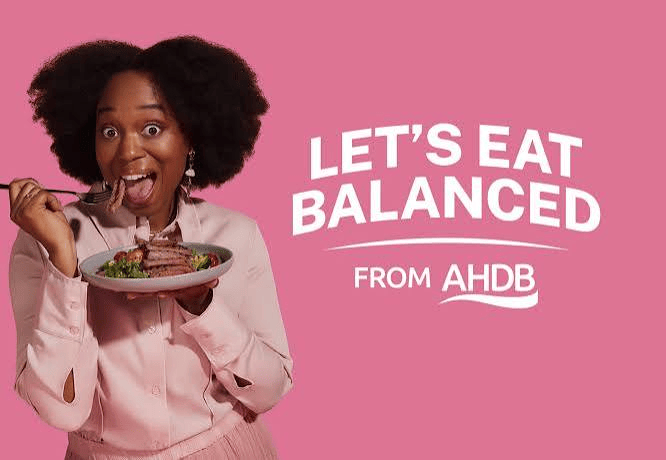
If Chris had bothered to go to his fridge and actually look at the meat and milk in it (and mushrooms for completeness), he’d likely see that it often does have health claims on too:
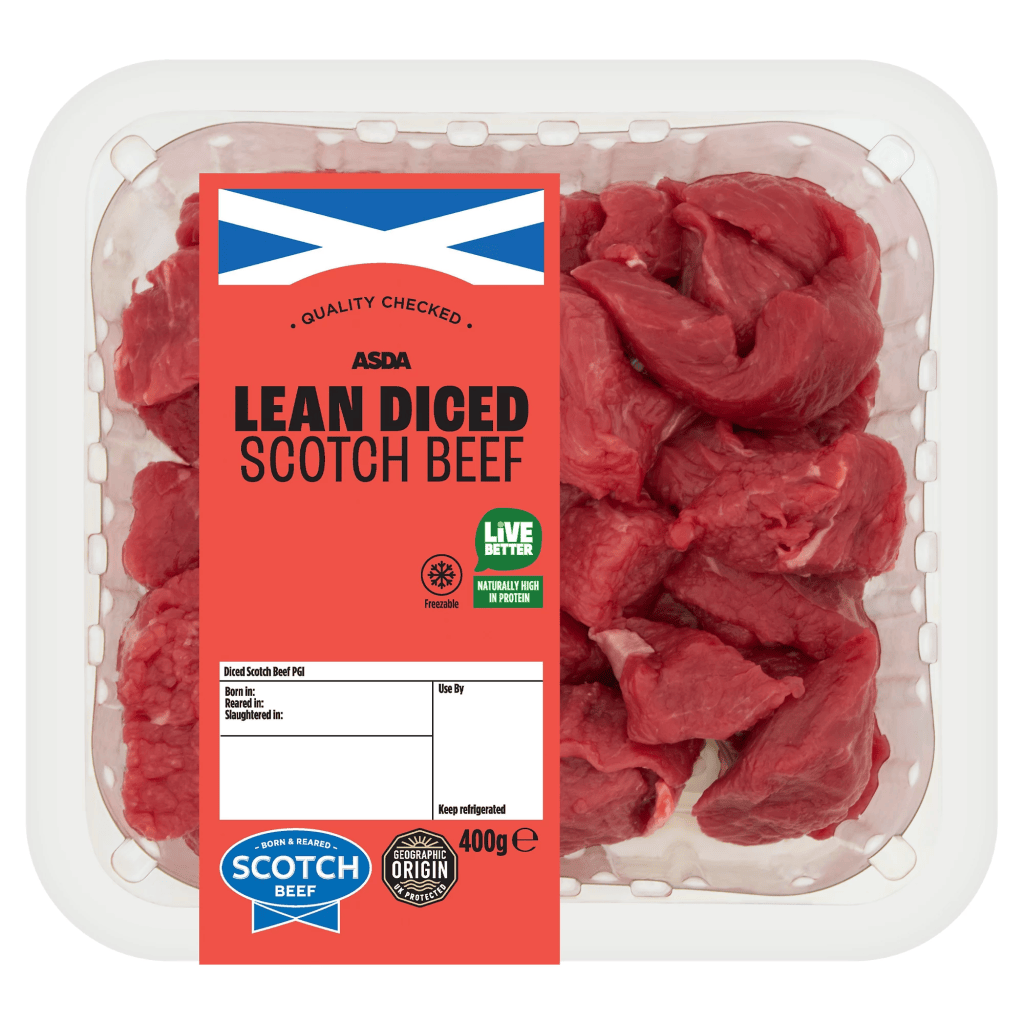
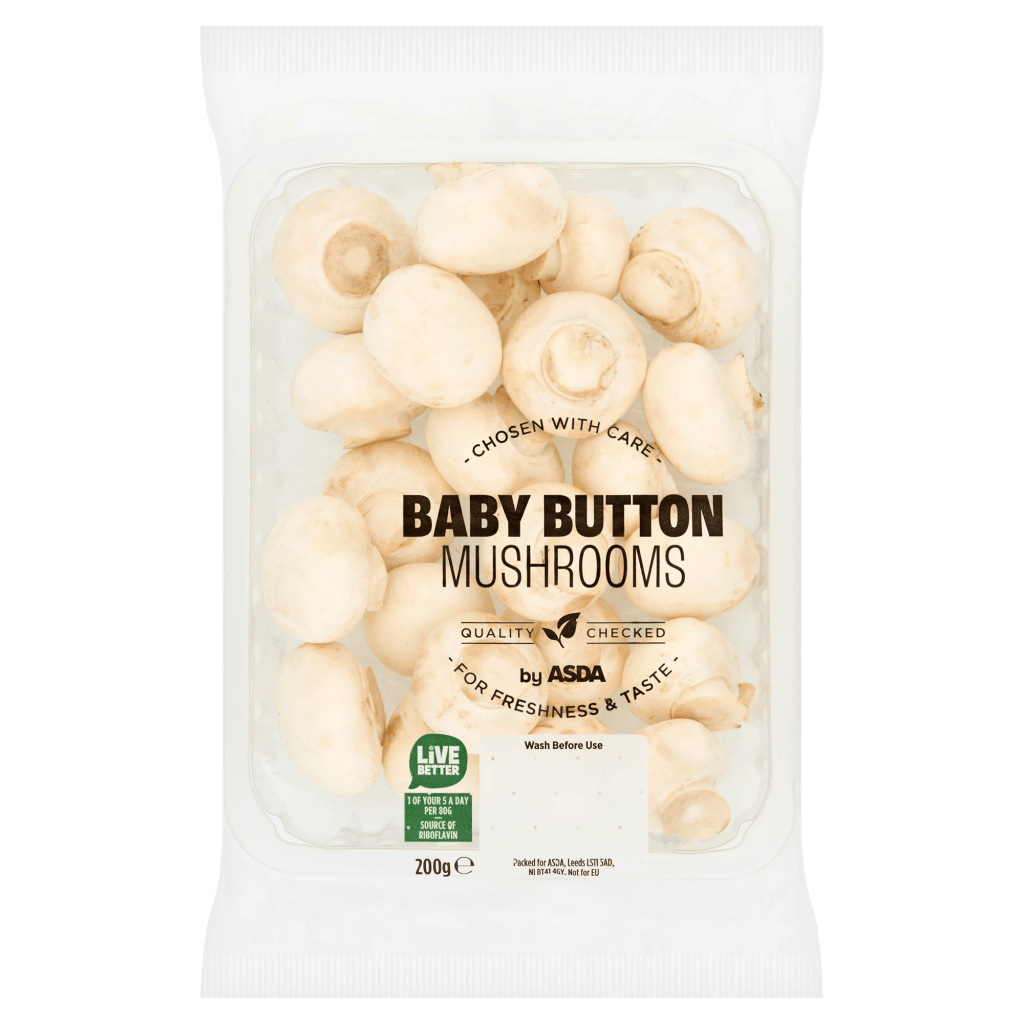
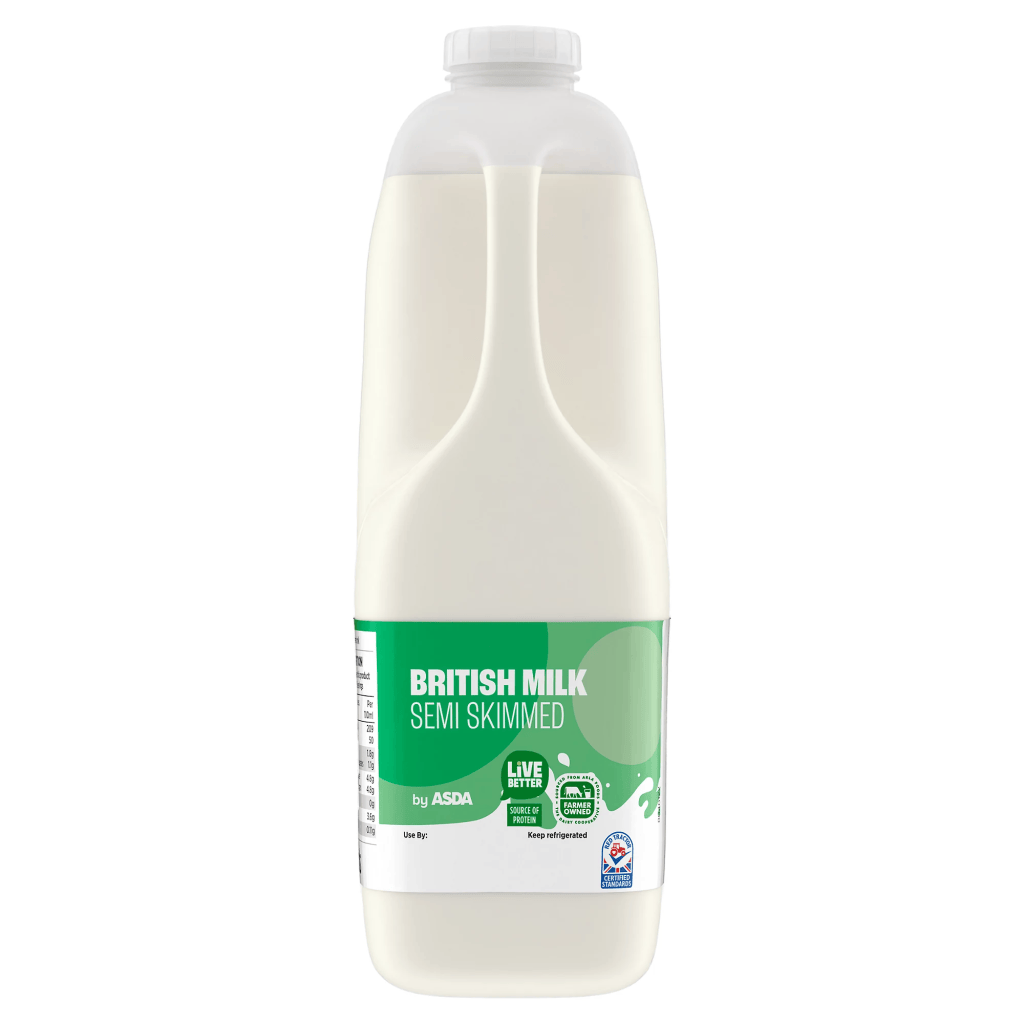
The above wasn’t hard to find – I literally opened the Asda website typed ‘beef’ ‘milk’ and ‘mushrooms’ and these were right near the top of each.
Now maybe this is new since 2023, but I really don’t think it is. This is just something I can only imagine he assumed but didn’t look into.
This kind of thing is also really not a one off. The whole book is littered with random statements that don’t contribute anything to the argument and are needlessly wrong:
“Many foods which contain all the amino acids, fatty acids, minerals and vitamins you need to survive, like beef and milk, don’t have particularly strong smells.”

I don’t know if this is just a poorly written sentence, or if van Tulleken is repeating a fairly fringe and incorrect assertion that beef and milk are nutritionally complete foodstuffs (you’re gonna need some vitamin C, E, and fibre at some point my guy), but if you’re a conscientious science communicator, it’s kind of on you to both be clear and correct.
There are some other bizarre coincidences, like how “the expert who made the deepest impression [on him] was Fernanda Rauber.”
As in, Fernanda Rauber, the lead author on this paper:
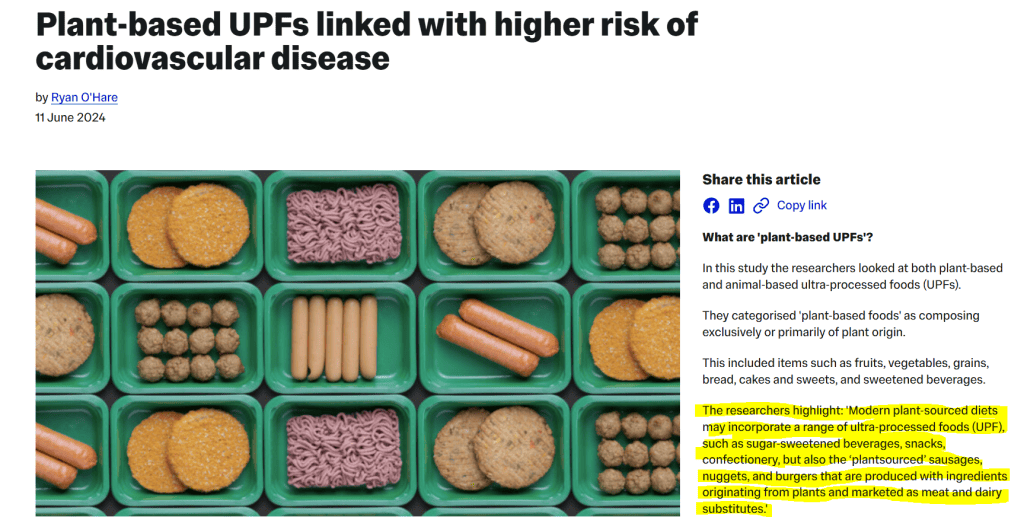
The way this paper was conducted and reported, was incredibly misleading, and the authors must have known this. ‘Plant-sourced diets’ sounds a whole lot like they looked at people following vegetarian or vegan diets, which they didn’t. The picture makes it seem like the main thing they were looking at was lant-based meat, which they weren’t. Their definition of a ‘plant-sourced’ includes fizzy drinks, cake, sweets, pepperoni pizza, salty snacks and literally any food that is not entirely meat, dairy or eggs. That’s not the interpretation any normal person would have of that term.
Plant-based meat is the headline image and the food most prominently highlighted in their ‘researcher highlight’, despite the fact they represented less than 0.2% of the UPF calories eaten in the study.
I don’t want to sound paranoid but…. this is weird right?
Plant-based meat isn’t being accidentally caught in the crosshairs of a bigger discussion here. The researchers are actively going out of their way to make strong inferences about it with no basis in evidence.
And the lead author is the person most influential on the public face of the movement’s latest iteration.
I do not like them Sam I Am
Imagine you are making a documentary series for the UKs public broadcaster the BBC about eating chicken.
Having prevaricated about decapitating your backyard chicken with a pair of secateurs, discussed cognitive dissonance with a psychologist, and interviewed a couple of people running a small chicken farm catering to high end restaurants, next you want to learn about alternatives to meat.
Who is the best person to interview about this? You ponder. Is it the many researchers who work on this in UK universities? Is it a person from one of the many plant-based meat companies in the UK? Or is it one of the world’s largest meat conglomerates?
I’ll give you a clue, it’s not the first two.
Cargill is a major player in the UK chicken scene, co-owning Avarra foods – the controversial chicken producer currently pushing for the deregulation of intensive chicken units in the UK. They are one of the largest single suppliers of the more than one billion chickens that are raised and killed for meat in the country each year.
But you are best-selling author Chris van Tulleken, and that isn’t what you’re here to ask them about.
After a brief, muffled interview with Cargill’s Vice President of Innovation and R&D, you conclude:
“Plant-based options are a sure-fire way to avoid the slaughter issue, but so many of the options I see at my local supermarket are, well, they’re just ‘weird foods’. We’ve taken edible plants, we’ve ultra-processed them to be an imitation of meat, adding all the necessary texturisers, emulsifiers, flavourings, dyes. I don’t think I can lose meat, only to fill my diet with stuff like this.”
Now Cargill does not own a single brand of plant-based meat that is available to buy in the UK. They make some ingredients and a couple of brands in other countries, but they should be pretty far down the list of spokespeople to ask about this topic.
If you don’t believe me, the episode is here, and the segment starts around 18 minutes in.
I have tried time and time again to have good faith on this topic. I have read a lot of UPF papers and two whole books that I frankly didn’t particularly enjoy, trying to understand and find some possible counter explanation for why this keeps happening.
But I can’t.
The modern manifestation of this whole discourse just hangs around a black hole of factory farming.
Where before we spoke about big meat, we now talk about big food. Where before we talked about processed meat, we now talk about processed food. The narrative has been diluted and robbed of both its explanatory and political potency.
Why does this discourse go out of its way to explicitly attack a food that is not functionally included in any of its evidence base? Why do they confidently weigh in on it when they demonstrably know nothing about it? Why every time you mention factory farming do they start complaining about the number of ingredients in a vegan burger?
If you do not like green eggs and ham. Nobody is making you eat them.
If you genuinely think chicken breast from a factory farm is meaningfully less implicated in the perverse incentives at play in our food system, explain why.
If you genuinely think that big companies can’t be trusted, don’t interview Cargill.
But from where I’m standing this is a narrative that takes the real problems with our food system, points the finger at foods it doesn’t personally like, and ignores the bits that it finds uncomfortable.
It’s fine to eat meat alternatives. Deal with it.
As you have probably gathered, this is a topic that matters to me on a personal level, too.
I’m going to out myself here, but I’m a vegan and have been for about a decade. I feel really lucky that I get to be vegan – I live in a country where it’s much easier than most, my body seems to take well to it, I’m fit and healthy and I have never had any particular nutritional challenges that some people genuinely do get. Before I went vegan I struggled loads with my weight and guilt around food (since the age of 15 my BMI has varied from below 18 to over 30). For me – going vegan meant I had a constructive reason not to eat all the (ironically UPF) foods I’d struggled to avoid before which so often contain random whey powder or gelatin. The foods I had binged on and then felt very guilty about. For the first time my eating patterns were being shaped by positive emotions, not negative ones. I eat way better now and it doesn’t feel like a constant uphill battle. For me, meat alternatives were what made it possible. They were a bridge to the things I always loved about meat, to Christmas dinner and Sunday lunch. They made having agency in my diet more accessible.
Im a fairly foodie person and healthy eating and constant whole foods just don’t spark joy for me. I appreciate this makes me sound like a child but wholefood diets make me feel tired and resentful of all the time I am spending making food I don’t feel excited to eat. I know wholefood diets really help others and that’s great, but hard as ive tried they don’t work for me. Every time I tried I failed and it made me miserable.
I’m not so hubristic to presume my n=1 extrapolates across the board, but something doesn’t have to appeal to everyone to be useful.
I’ve never received any money from any company that makes plant-based meat or any food producer whatever for that matter. I took a pay cut to leave my old career and work for a non profit that works on healthy sustainable diets. Im not a famous TV presenter with a big platform and a best-selling book, I cant take out ads at the Super Bowl.
The axe I have to grind with Nova wouldn’t exist were it not for the fact that so many people with a lot more power than I do have taken it upon themselves to attack something that means a lot to me, without bothering to look into it first or get their facts straight.
A solution diluted is a solution halved
The fact that from the 1980s to the early 2000s big tobacco owned huge swathes of the food and drink industry, and disproportionately filled their products with salt, sugar and fat is reprehensible. The fact other companies felt compelled to follow suit or lose market share is arguably even more damning as a system where public health is being directly pitted against profit. But while Nova seeks to be a framework that characterises corporate influence in the food system, I’m not convinced it does so very effectively.
I don’t believe for an instant that most people who work on Nova think big meat is good, but in the popular imagination (regardless of what is intended by genuine advocates) Nova by its construction has severe blind spots, and these are being exploited. The anti-industry bent of the discourse makes it the perfect cover for big meat, and we see in the financial filings of lobby groups like the Center for Organizational Research and Education, that they are specifically using UPF to undermine meat alternatives:
“CLEAN FOOD FACTS EDUCATES CONSUMERS ABOUT WHAT IS ACTUALLY IN THESE PRODUCTS, SINCE FAKE MEAT IS OFTEN PROMOTED AS HEALTHIER, DESPITE BEING ULTRA-PROCESSSED [sic].”
Coca-Cola and Cargill are both products of the same system. It doesn’t make sense to acknowledge half of the problem while ignoring the other, and it’s naïve to think that industry influence stops at Nova 4. This isn’t a kid’s book: I don’t like pastured beef on a train, you don’t like mycoprotein on a plane, and I don’t think that’s likely to change anytime soon. However, fighting over our personal preferences doesn’t help anyone. A critique of big food that does not meaningfully address big meat is not a serious one, and until Nova plugs this gap, it isn’t either.

