Unlucky for us, we live in interesting times. While there are a lot of elements contributing to the current moment being quite so interesting, nowhere are they more clear than in public health.
February’s edition of The Lancet contains a front page editorial lambasting Robert F Kennedy’s actions in his first year as US Secretary for Health and Human services – warning against the dangers of politicising science. Whatever a UK-based medical journal hopes to achieve by dedicating its cover story to a non-technical opinion piece about a US politician, the idea this is going to lessen the growing chasm between populist politics and science is a bit of a stretch.
Kennedy’s outspoken NIH director Jay Bhattacharya was quick to respond:
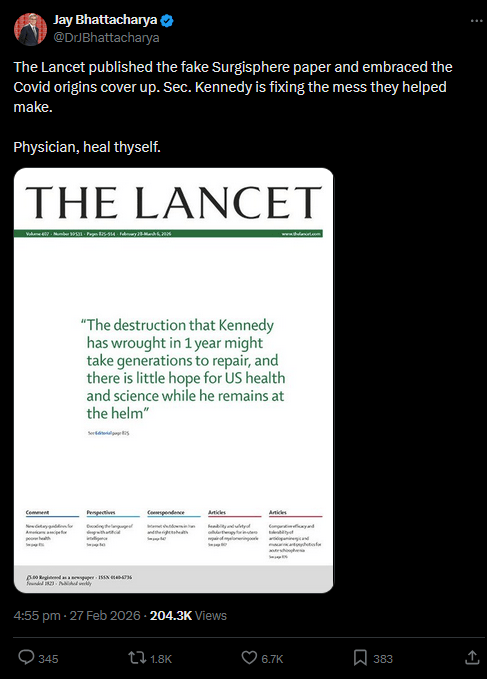
While one only needs to look at measles rates in the US to see the very real consequences of RFK’s policies and lost trust in science more broadly, there is an uncomfortable truth in the suggestion that his rise is a symptom of a deeper underlying problem. After years on the fringes, during the pandemic Kennedy’s popularity skyrocketed, and this wasn’t a coincidence.
Particularly in the US, where medical costs are extremely high and access often limited, there was a lot of latent distrust coming into the pandemic. In this context, when scientific institutions needed trust more than ever, they spent credibility they hadn’t earned on battles they didn’t need to fight.
Episodes like the Surgisphere scandal from Bhattacharya’s tweet are a clear example.
At the dawn of the pandemic, researchers scrabbled for a way to lessen the severity and transmissibility of the illness. Several hypotheses and drugs were investigated, one of which was the drug hydroxychloroquine, used to treat inflammatory diseases and malaria, and another was ivermectin, an antiparasitic drug. Preliminary lab research published in March and April 2020 had indicated they could be helpful against the virus, and both became highly sought after and promoted by a number of prominent public figures including Trump. However, when later, more robust studies found that these drugs did not seem to help in the real world, it led to confusion. As such, there was a lot of pressure to find more evidence with which to explore the link.
So when a tiny, previously unheard of start-up claiming to have exclusive access to huge volumes of extremely valuable health data popped up promising a solution, it sounded almost too good to be true.
Surgisphere’s dataset was used to produce 3 research papers before it was discovered that their promises absolutely were too good to be true and the dataset they sold was entirely fabricated. What is more, not one but two of these papers ended up in the two of world’s most prestigious medical journals, the New England Journal of Medicine and the Lancet. The third looked at Ivermectin and was only ever published as a pre-print.
The paper that caused the scandal to be revealed purported to find that – contrary to claims from Donald Trump and others – hydroxychloroquine not only failed to protect people against Covid19, it actually significantly increased risk of death from the disease.
The Lancet issued a press release on the study’s findings upon publication, and unsurprisingly the Trump angle was seized upon by journalists. Widespread complaints erupted in the following days highlighting that some very obvious red flags had been missed during peer review.
While the paper was swiftly retracted, this came too late.
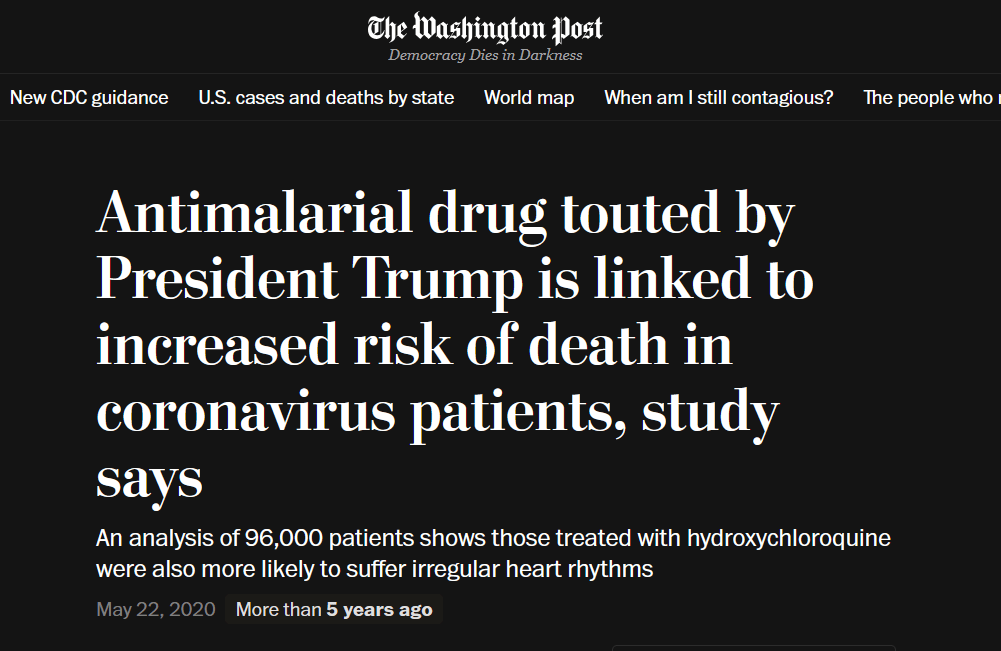
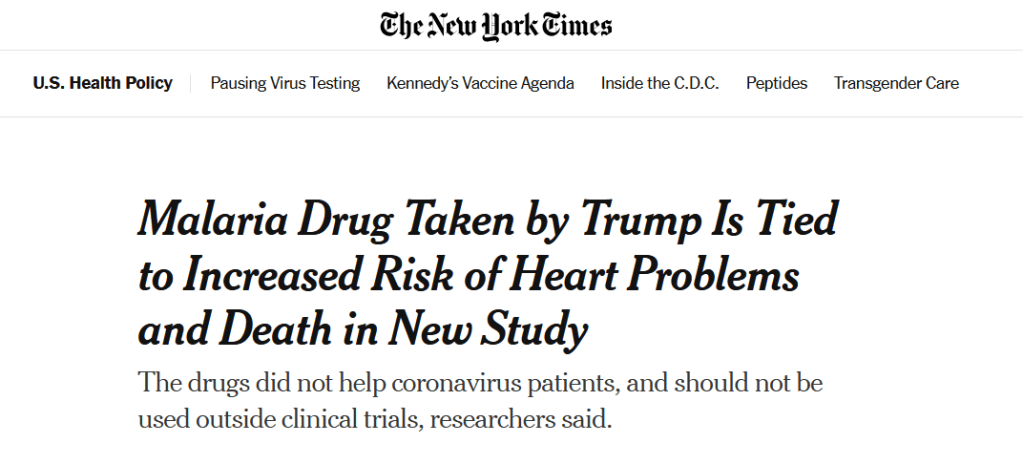
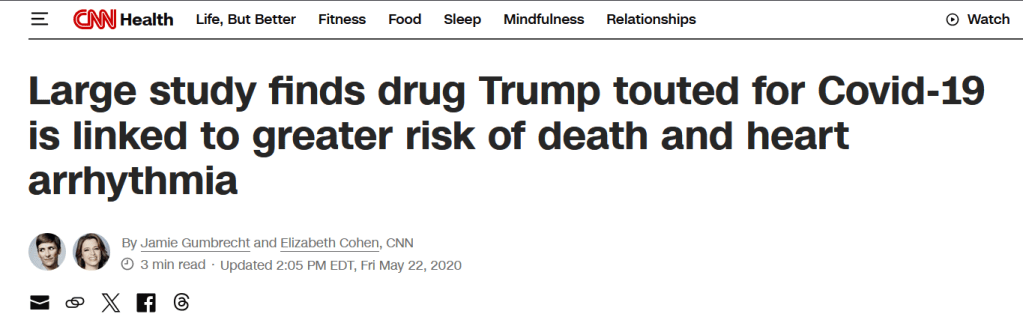
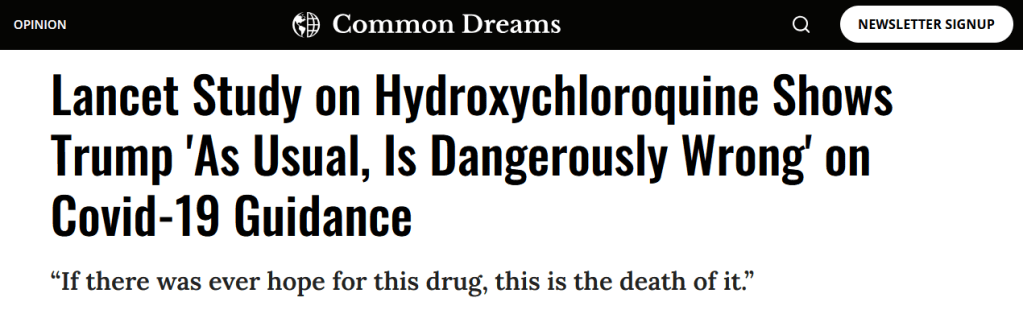
The fact that the paper underlying the first major scientific scandal of the pandemic had a lot of political baggage was unfortunate, but the broader academic community reacted swiftly and the paper was promptly retracted.
The oversight of the journals in press releasing shoddy research that would later turn out not to be true didn’t inspire confidence, but these were extraordinary times. However, in the debate over COVID-19’s origins, it translated into active suppression.
The main competing theories were that either the virus had jumped into humans via a wet market, or it had escaped from a virology lab where novel coronaviruses were being studied – the so-called ‘lab-leak’ theory.
Both had their proponents within the academic community, but a WHO investigation came down strongly on the side of the wet market, while a group of scientists took an even stronger position in a letter published in the Lancet, which sought to “strongly condemn conspiracy theories” of the lab-leak theory.
This was somewhat premature given the limited available evidence at the time, coming shortly after a paper – also in the Lancet – on the first cases of COVID-19 which showed the first recorded case had no contact with the market, and took place over a week before any which did.
What is more, the graph displaying this information in the paper had a suspiciously broken x axis which – to someone who didn’t trust the journals – might look like an attempt to paper over inconvenient information.
A helpful reminder that the space you save by breaking axes is never worth it.

Tweets about the ‘lab leak’ theory had warning labels added to them, and facebook posts about it were even banned for a time. While the data are uncertain, and the political quagmire the discourse has become makes it hard to know anything at this point, the lab-leak theory today is generally considered at least plausible and by many the more likely hypothesis.
The overbearing response to the hypothesis again fed the impression that ‘science’ was primarily being used as a political tool, rather than a framework of gaining objective knowledge. This was not helped by revelations that key players in doing the quashing had undisclosed conflicts of interest, and it is very clear in hindsight that the suppression of a hypothesis which later proved credible validated conspiratorial thinking.
In the December 2020 and January 2021, the findings of the first phase 3 study of the Pfizer Biontech vaccine and the Oxford Astrazeneca vaccine respectively were published. They were published in the very same journals that had 6 months previous been at the heart of the Surgisphere scandal, and in the case of the Lancet had represented a central institution in the denunciation of the lab-leak hypothesis.
If you’re familiar with the research itself, the vaccine trials were robustly designed RCTs, conducted in parallel by multiple well established independent institutions from across the globe. They contained thousands of participants and doctors and researchers and administrators. They were clearly much more robust than either the Surgisphere or covid origins research- even before the scandals emerged.
Most people aren’t familiar however, and we can’t expect them to be. The public has no choice but to put their faith in experts, so they need to know they can trust those experts.
This was a time when those already suspicious of the scientific establishment were being asked to take it at its word and make genuine sacrifices on its behalf, while a lot of the people they listened to and trusted told them they were being tricked and lied to. If the public health messaging had any hope of getting through, it needed to be impartial.
And while the scientific establishment broadly stuck to these more specific research questions, the cultural atmosphere they helped create produced something uglier. The subreddit /r/HermanCainAward shared examples of people who had not been vaccinated dying of COVID-19 in posts attracting widespread popularity on the site. Decorated political cartoonist Bill Bramhill presented those unwilling to be vaccinated, overweight and clad in a distinctive red cap, perched upon a dead weight holding ‘everyone else’, not overweight and responsibly wearing a mask, back from herd immunity. Prominent celebrities and public figures made extreme comments calling for the unvaccinated to be denied medical care, which were widely plastered across headlines.
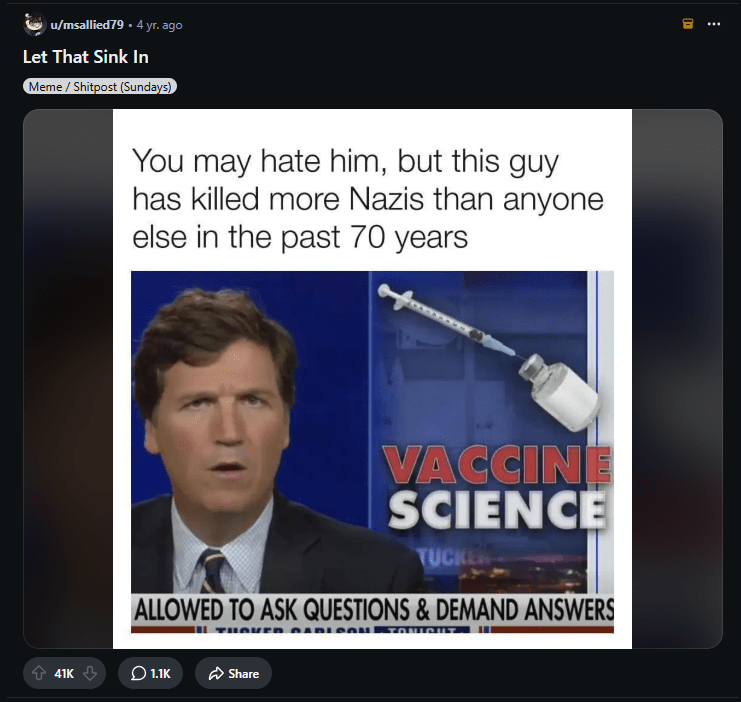
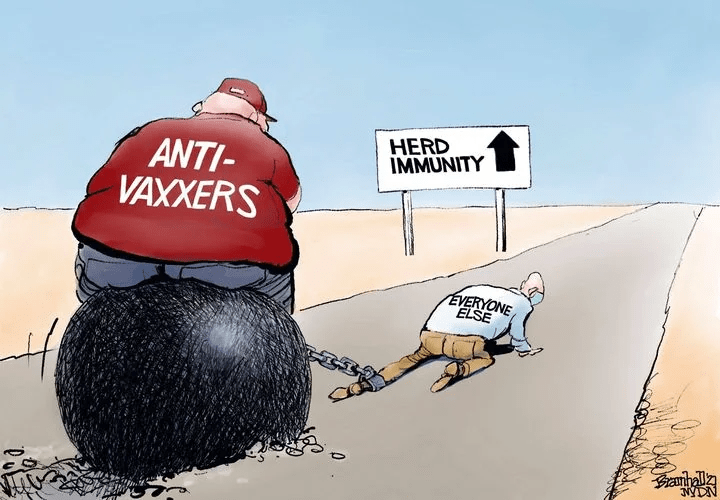
Generally accusing those you disagree with (even on something really important) of being Nazis undeserving of medical care is not in-keeping within Mertonian norms and not particularly productive.
As the pandemic fades further into the past, it’s hard not to feel like it broke something that is going to be very difficult to fix. However, it isn’t the first time that such a disenchantment has happened, and it is notable that in this instance – as with those before it – the people turning away from conventional medicine had grown increasingly unconvinced that the scientific establishment had their best interests at heart.
It feels overwhelming, but we need to remember that these problems aren’t new, and they aren’t inevitable.
The inauspicious origins of vaccination in public health
For as long as there have been vaccines there have been skeptics. This image of a ravenous pox-infested cow being fed screaming children is taken from an early antivax pamphlet (relative to the low effort memes of today, it’s fair to say the movement has lost some panache).
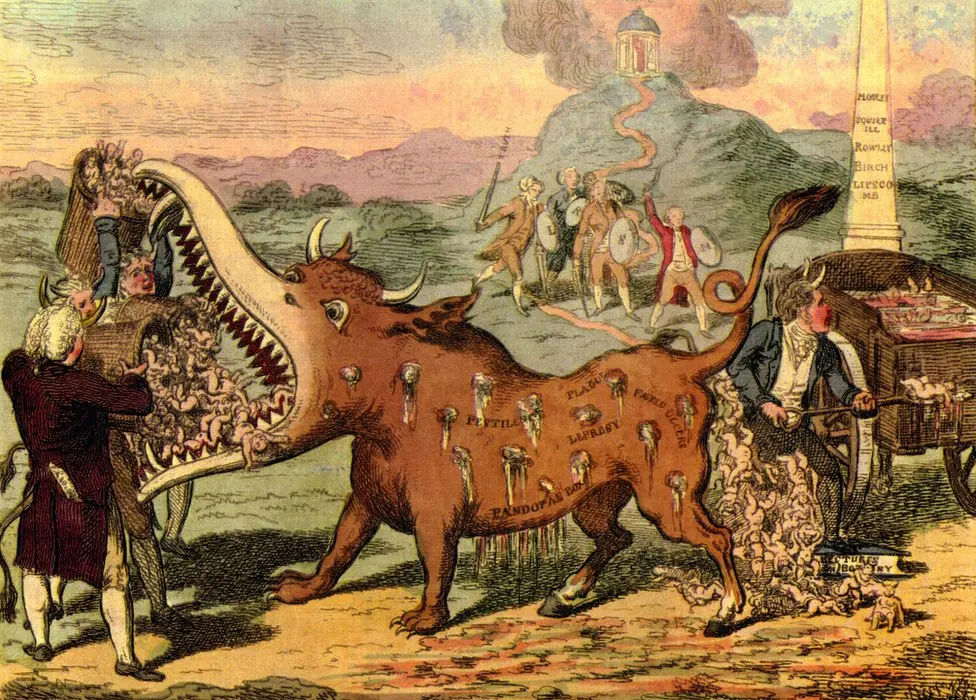
The chances are, you have never met someone who has had smallpox, but this disease was until very recently one of the biggest killers humanity faced. The scars on the mummified body of Rameses V, an Egyptian pharoh who died over 3,000 years ago, are thought to be signs of the ‘speckled monster’. It laid low entire cultures as it was spread to the Americas by colonial Europeans, from the population collapse of the Aztec empire, to the devastation of the great dying among the Wampanoag and Abenaki peoples in what is now New England. Even in Europe where immunity was higher, Swedish records indicate that before vaccination, one in 10 children died from the disease.
The earliest confirmed records of variolation – the precursor to vaccination – originate in China in the 1500s – though older unverified reports and popular folk traditions from several countries exist. It involved the intentional infection of healthy people with a small dose of degraded smallpox virus – often in the form of scabs or pus- to elicit a low level infection. This exposure protected against ‘natural smallpox’ later down the line.
Variolation was not risk free. About 1-2% of the time it led to full blown smallpox, and even if it didn’t, in the days following treatment people were often still contagious. Considering ‘natural’ infections had a mortality rate of 20% or more, with many who survived permanently disfigured or blinded, this was still a significant improvement.
Variolation reached Western Europe via the Ottoman Empire in the 1700s, where it was seized upon and championed in the UK by Lady Mary Wortley Montagu – who after first giving her children the procedure sought to convince others in the nobility of its importance.
The medical establishment monopolised the procedure in short order, employing increasingly elaborate techniques with extensive preparation, often including fasting, purging and bloodletting and complex medicinal concoctions. Several also adopted methods where the smallpox matter was inserted into deep cuts – which discouraged attempts by people without qualifications. Due to their complexity, in addition to being traumatic, these treatments often came with a prohibitively high price tag.
As a consequence, it was only a matter of time before outsiders stepped in to fill the void.
The Sutton family were probably the most influential of these outsiders, and built a business empire offering their new variolation method, first conceived by Robert Sutton and perfected by the tireless experimentations of his son Daniel.
Contrary to the methods employed by the members of the Royal college, the Suttonian method used only a very shallow scratch that didn’t go deeper than the skin. It also skipped the weeks of gruelling ‘preparation’.
The combination of these two factors meant that the Suttonion method was not only much cheaper, it was also much safer than the ~1% mortality rate of establishment methods (of Daniel’s 22,000 administered inoculations there were only 3 reported deaths). Unsurprisingly, the Suttons’ services became incredibly popular, much to the chagrin of the medical establishment.
The Suttons also cared what their patients thought of them. According to the writings of Robert Houlton – a local clergyman hired by the Suttons to build awareness of their new methods – the family faced unrelenting hostility for their work from the royal college, without a great deal of justification. As it would turn out, the public had a lot of sympathy for the Suttons, not least because the disdain of the establishment recounted by Houlton was all too familiar to them.
Houlton painted the establishment as out of touch with their patients, and obsessed with the ‘secret’ of the Suttonian method (despite the fact it wasn’t a particular secret). Some even went so far as to pay ex-patients for any information they could offer on Sutton’s treatment. They would then publish these methods, with attribution only to ‘a certain person and his sons’ and complain that they didn’t work.
In Houlton’s opinion this obsession spoke volumes about the hubris of the establishment, who would rather believe that the Suttons were jealously guarding some secret regimen of chemicals applied in just the right way than acknowledge their own shortcomings. Who would happily accuse Sutton of crass mercantilism in selling his ‘miracle method’ to the masses while their own -less effective- services were far beyond the means of normal people. Houlton suggested instead that the ‘secret ingredient’ was in fact Daniel Sutton’s diligent research, empathy for his patients, and the way he tailored treatment approaches to meet patient’s individual needs.
Some critiques from the establishment do seem to have carried a bit more weight, however. The explosion of newly inoculated people, contagious after their treatment, was very concentrated around the Sutton clinics. These people now wandered the streets rather than remaining in the confines of expensive facilities, risking outbreaks of ‘natural’ smallpox. This caused so much concern that Daniel Sutton was put on trial by the local authority, abetted by the local establishment doctors.
But far from silencing him, the case catapulted Sutton further into the public eye when Houlton leveraged the sympathies of the public in a popular satirical play, entitled ‘The tryal of Mr Daniel Sutton for the High crime of preserving the lives of his majesty’s liege subjects by means of inoculation’.
The pamphlet hit back at the medical establishment for putting their own pockets, prestige and power ahead of the wellbeing of the general public, while also acting as a not so subtle advert for Sutton’s services.
The charges, as charaterised in the pamphlet, were described thus:
“you by inoculating, and causing to be inoculated, and by means of certain secret medicines and modes of practice, unknown to this College and to all other practitioners, not having the fear of the College in your heart, do presume to preserve the lives of his Majesty’s liege subjects and that more especially during the three years last past, you have inoculated, or caused to be inoculated, twenty thousand persons, without the loss of one single patient by inoculation, contrary to the statute in that case made and provided.”
As in real life, the pamphlet ends with an acquittal, and the public siding firmly with the Suttons.
Another very popular non-establishment trailblazer of this period was Johnnie ‘Notions’, described later in a history of smallpox in 1857 as a ‘common, uneducated, but very able peasant,’ from the remote Scottish Shetland islands. A crofter by trade, Notions was also a self-taught physician and inventor. He developed his own exceptionally effective variolation method, ending the brutal smallpox outbreaks that had haunted the small island community for decades.
The Statistical Account of Scotland published in the 1790s describes Notions as an itinerant – offering his procedure to whoever needed it in the community regardless of their ability to pay and charging even the wealthy only a fraction of the going rate. Through his work, he earned the high esteem both of his island community and visiting doctors.
Sutton and Notions would both soon be overshadowed however, with the advent of vaccination popularised by Edward Jenner at the turn of the 1800s.
Jenner was firmly a member of the medical establishment, but unlike the fellows of the society who had snubbed the Suttons, his approach clearly worked. Vaccination leveraged the cow pox virus – a non lethal ‘relative’ of smallpox – and provided immunity to the disease without ever having to run the risk of contracting it. So remarkable was it that Napoleon – at the time at war with Jenner’s native UK – having vaccinated the french army complied with a request from Jenner to release two British prisoners of war, with Napoleon stating he could not “refuse anything to one of the greatest benefactors of mankind.”
The fact that – on paper – the vaccine carried no risk led the UK government to take the unprecedented step in the mid 1800s of introducing state-sponsored vaccination programs, made available free of charge to everyone.
However, while cowpox itself was not lethal, and carried lower risks of contagion than earlier variolation, the poorly run and unsanitary state of many publicly funded vaccination centres sometimes led to secondary infections with other serious diseases like syphilis and hepatitis. Doctors were also not always sufficiently trained, and sometimes took the wrong bodily fluids from the cows they used as reservoirs for the vaccine. In the words of health reformer John Simon in 1857, there was “not only an appreciable amount of utterly incompetent vaccination but a very considerable proportion of second-rate vaccination”.
This would have been less of a problem had the program not also made vaccination mandatory.
It did not go unnoticed by the working class people forced to take the free vaccinations from poorly run and unsanitary centres – that middle and upper class families in their own private facilities were not being asked to take the same level of risk ‘for the greater good’.
It was also very clear that the primary motivation for this was not to benefit working class families per se. After all, they still allowed the employment of children in mines and dangerous factories, and had done little to alleviate the poor sanitation and poverty which enabled diseases to spread.
While some local councils had paid for the local poor to receive variolation for some time even before Jenner invented vaccination – their rationale was primarily economic. As a contemporary account in Peter Razzel’s comprehensive history of smallpox recounts:
“The inhabitants of a certain parish had a meeting to agree on inoculating all the poor, some medical gentlemen in the neighbourhood offered to undertake the business at a very low price; but as cheapness was the only object of consideration, the parish was about to agree with a blacksmith at eighteen pence a head, when one of the most frugal stated this objection: ‘It is very probable that under this man’s care we may have some die, and the expence of their burial may cost the parish so much, that it might as well agree with a better man.’ This objection was thus removed by the smith: ‘Come, I’ll tell you what I’ll do with you – Give me half a crown a head, and them that die I will carry to the Churchyard without putting the parish to any further expence.[sic]”
People hadn’t flocked to the Suttons entirely because what they offered worked, although that clearly helped. The Suttons worked to earn the trust of their communities in a way the medical establishment never did, they put effort into building a positive reputation and cared what the people attending their clinics thought and felt. Even the people of the Shetland Isles, who had suffered so much at the hands of smallpox, and so enthusiastically taken to the variolation procedures of Johnny Notions, greeted the arrival of vaccination with frosty skepticism.
Knowing what we know now this seems hard to comprehend, but it shouldn’t be. If a medical establishment who has long treated you with open disdain offers you a medical procedure and tells you its for your own good, it seems reasonable to have reservations.
Over time, as the vaccination centres and vaccines improved, so to did trust, allowing smallpox to be effectively wiped from the face of the earth.
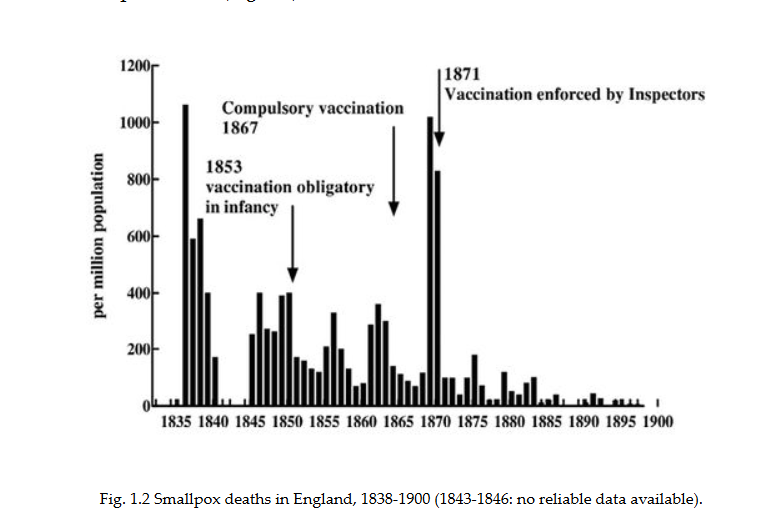
However, while mainstream recognition of the importance of vaccines became commonplace, that initial hostility never completely died. Tellingly, hesitancy often lingers most strongly among marginalised groups, and those who are routinely excluded from care through cost.
We are currently living through uncertain times. The widening gulf between large segments of society that often feels unbridgeable is scary. Watching people seeking to tear down a technology that has saved more human lives than possibly any other in history is heart wrenching, and few things are more rage inducing than watching with very little agency as thousands of children get sick from something that could have been prevented.
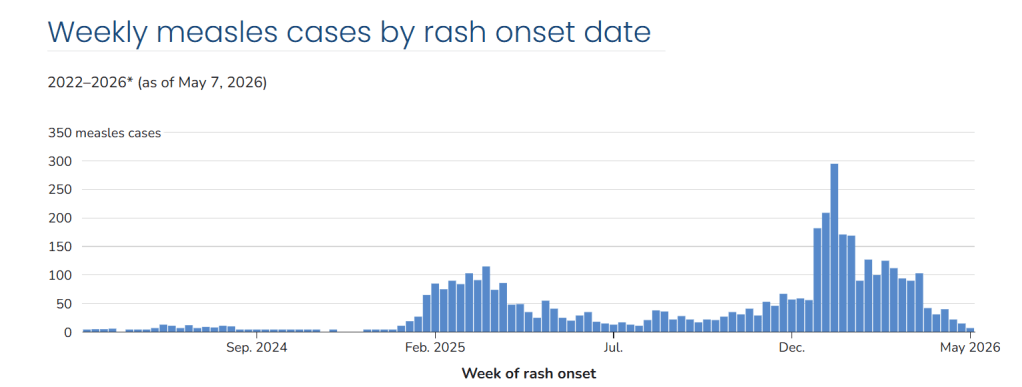
But medicine must be for everyone, and while calling Kennedy an idiot is cathartic, it doesn’t change the minds of the people who follow him. If anything it pushes them further away. Viewing ‘science’ as a stick to beat opponents with is a slippery slope, and encourages the conflation of opinions with scientific fact. Without better discipline on which battles to pick, and higher evidential standards, the truth will continue to lose ground with those on both sides.

